

By Geena Monahan—For the North Star Reporter
Editor’s note: This story is part one of a two-part series. Next week’s installment will explore Salemi’s memories of life on the homefront, including the Great Depression, the moon landing, the evolution of technology, Sept. 11 and what it’s been like to watch his country change over more than a century.
This July, the United States will celebrate its 250th anniversary and North Attleborough’s Caster Salemi has been alive for 104 of those years.
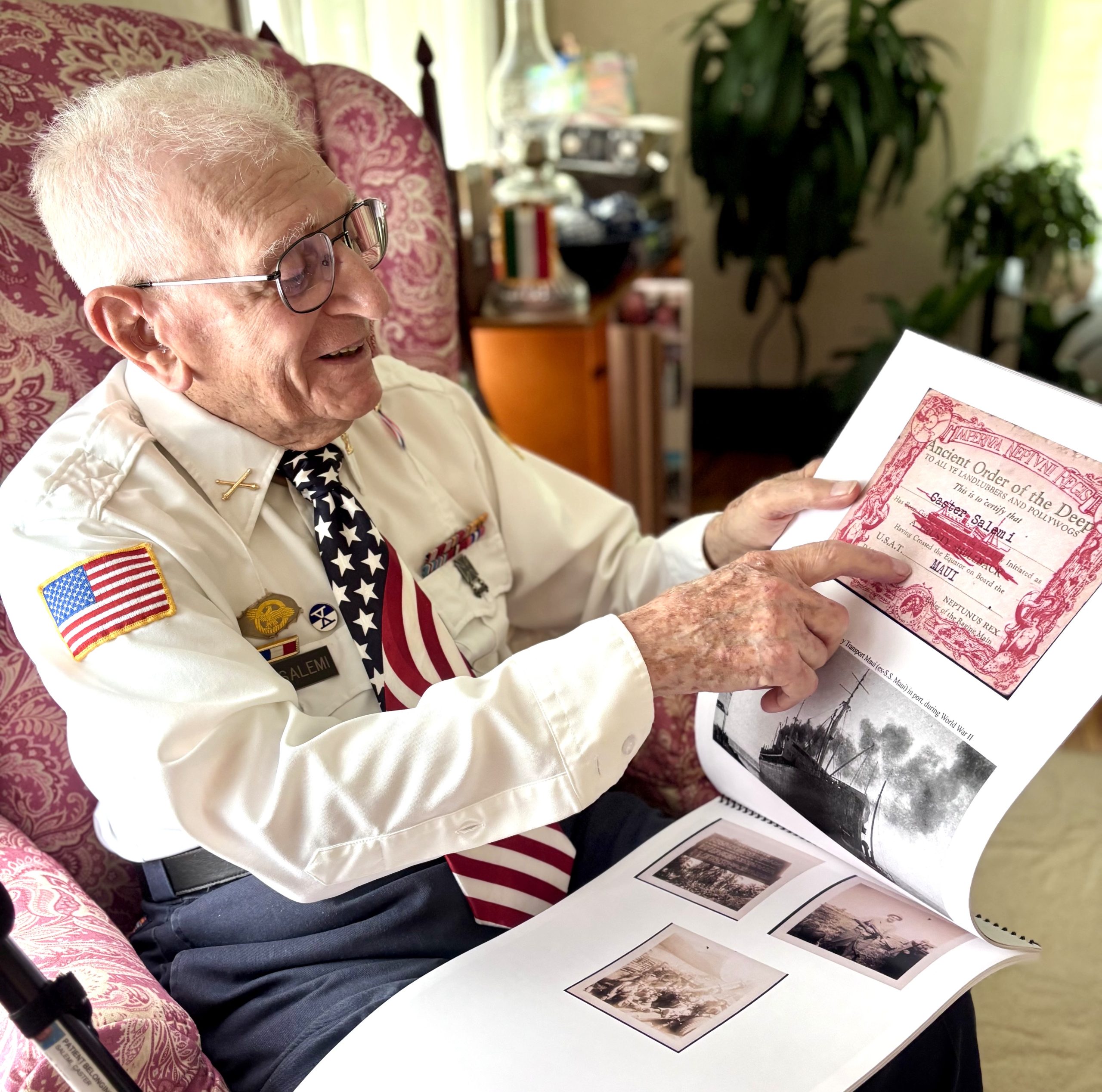
On a June morning in his Metcalf Circle living room, Salemi flipped through an album his children created after digitizing decades of family and military photographs. Around him sat reminders of his service — wartime images, military memorabilia and even a bottle of Salemi wine he opened to mark his 100th birthday.
Later that day, he planned to attend his weekly trivia game at the North Attleborough Senior Center before joining fellow members of the Italian American War Veterans of the United States Providence branch for dinner in Rhode Island. Between veterans’ events, historical reenactments, podcasts and interviews, he spends much of his time sharing memories from a life that has spanned more than a century of American history.
“No, not at all,” Salemi said when asked whether he ever tires of telling those stories. “I get to meet a lot of people that way.”
From Prohibition and the Great Depression to the moon landing and the digital age, Salemi has witnessed sweeping change — but his memories of World War II remain especially vivid.
Growing up in New York
Born in Manhattan to Sicilian immigrants, Salemi moved with his family to Queens as a young boy, where his parents ran a neighborhood grocery store.
“We didn’t have many toys,” he said. “When I learned to ride a bike, I’d deliver groceries for the store. That’s where I made my spending money.”
After graduating from Brooklyn Technical High School, he worked as a light installer before taking a job with New York City’s subway system. He tried to enlist in the Navy, but was rejected because he was colorblind. Instead, he went to work for the Sperry Corporation, helping manufacture Norden bombsights.
Everything changed on Dec. 7, 1941.
“I was at a basketball game at the high school when Pearl Harbor happened,” he said.
Not long afterward, he was drafted into the Army.
“It was something I wanted to do,” Salemi said. “But we had no choice where we wanted to go.”
After processing on Long Island, Salemi boarded a train bound for Paris, Texas, where he trained for a year before being sent to California. There, soldiers traded heavy wool uniforms for lightweight khakis.
“We knew then we were going somewhere warm,” he said.
Into the Pacific
At 21, Salemi spent 31 days crossing the Pacific to New Guinea for additional training. Fresh water was reserved for drinking, so showers came only when it rained.
“If it rained,” Salemi said with a laugh, “everybody got out on deck and took a shower.”
The first sight of land brought excitement — quickly tempered by reality.
“We said, ‘Oh boy, land!,'” he recalled.
There, they found towering kunai grass that had to be cut away before camp could even be established.
Salemi then deployed to Luzon, an island in the Philippines, with the Army’s 25th division, 251st Field Artillery Battalion, Battery B. Assigned to communications, he ran telephone lines between firing batteries and headquarters, because radios often failed in the jungle.
“We were in combat from the first day we got there until the war ended,” he said.
Though positioned behind the front lines, Salemi’s unit frequently came under fire.
“We were attacked quite a few times by Japanese artillery,” he said. “That’s where we suffered most of our casualties. We lost about 10% of our outfit.
“The Japanese knew they were losing,” he added. “They kept moving farther north, and we were chasing them.”
Combat in the Phillipines
Japanese forces once caused a stampede of a herd of carabao — massive water buffalo — directly toward American positions.
“All of a sudden we heard this rumbling,” Salemi recalled. “They stampeded them toward us, and we had to hide anywhere we could so we wouldn’t get run over.”
Other memories are harder to revisit, including an artillery strike that hit a foxhole occupied by cooks and helpers.
“That was sad,” he said quietly.
He also recalled the months-long battle at Balete Pass, where American forces fought through heavily fortified Japanese positions hidden in mountain caves. When the fighting subsided, his unit was tasked with recovering and burying the dead.
Salemi was still in the Philippines when word spread that the United States had dropped an atomic bomb.
“We didn’t know what an atom bomb was,” he said. “We didn’t know the damage it could do.”
Soon afterward came the order to cease fire and news that Japan had surrendered.
American troops then helped escort Japanese prisoners to Manila before they were repatriated. During one assignment, Salemi was paired with a Japanese nurse who spoke some English and had spent 12 years caring for wounded soldiers while Japan fought in China.
“She said it was tough because people were getting hurt every day,” he recalled.
Salemi also remembered the relationships American troops formed with Filipino civilians. When his unit once ran out of cooking oil, several soldiers slaughtered a pig and rendered every usable part — sharing what remained with nearby civilians.
“The Filipinos were friendly to us,” he said. “Whatever we had left over, we’d give it to them.”
Life after war
Salemi returned to California aboard a hospital ship after being honorably discharged in 1946.
“We hit the aftermath of a typhoon and we were going up and down waves that were 40 feet high,” Salemi recalled of his trip back to America. “To this day I won’t go aboard a ship on the ocean.”
While recovering in a hospital from jungle rot – a fungal infection that had left him barely able to walk – Salemi and other veterans heard what sounded like incoming artillery.
But it wasn’t enemy fire — It was a jet airplane, the first any of them had ever heard.
“We all rolled off the beds and got underneath,” he said.
Like many veterans, Salemi focused on building a life after the war.
“Everybody was meeting girls, getting married and starting families,” he said. “Everybody went their own way.”
Years later, after becoming active in veterans’ organizations, Salemi began speaking publicly about his experiences. Today, he continues to share them — not for recognition, but because he believes they still matter.
“It’s not that,” Salemi said. “I just want people to know that we’re still around.”