

By Geena Monahan—For the North Star Reporter
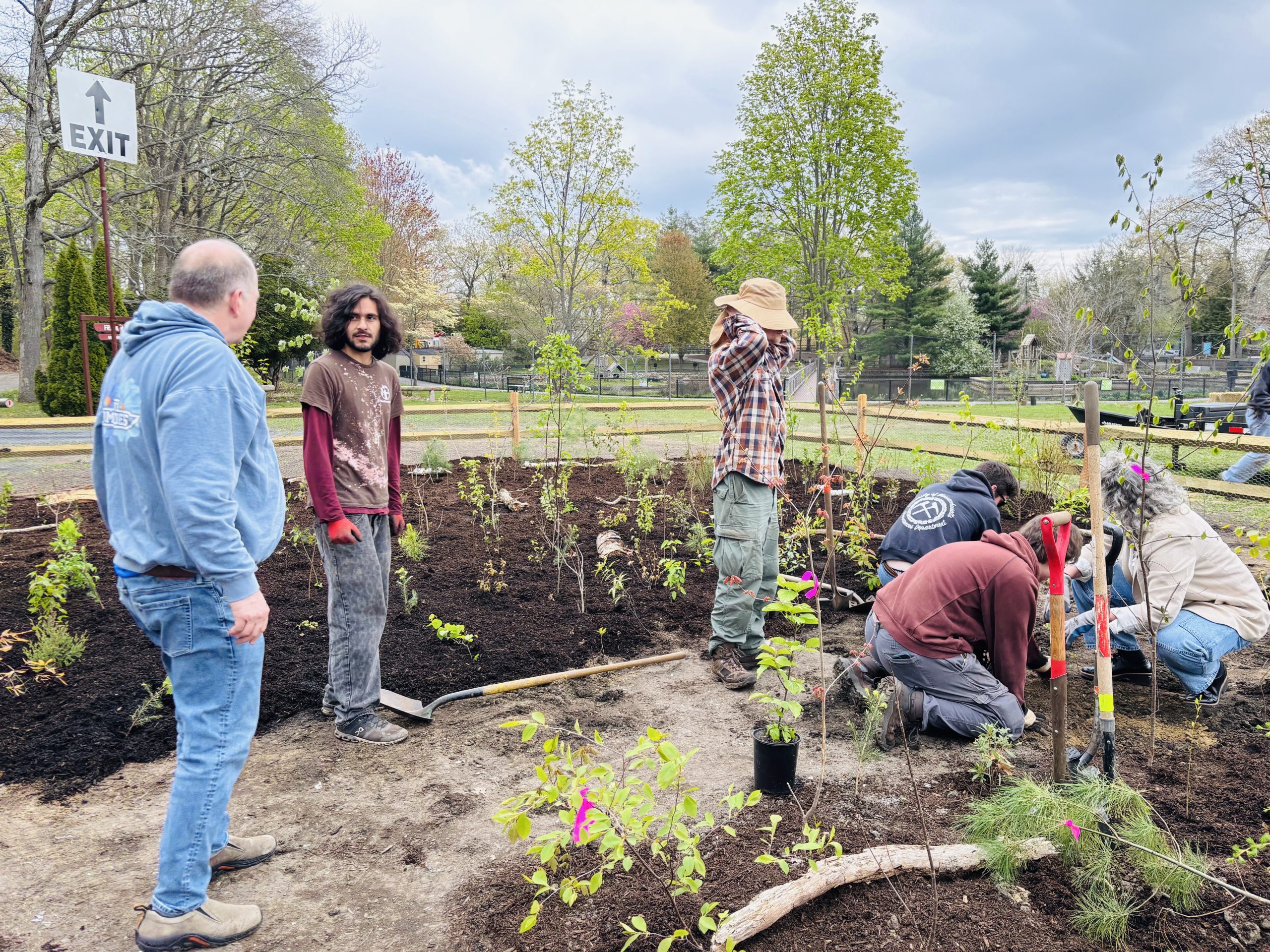
At Attleboro’s new Miyawaki forest, an unused baseball diamond at Capron Park is being transformed into a dense pocket forest designed to absorb stormwater, cool surrounding neighborhoods and restore biodiversity.
“The idea was to take a former baseball diamond that wasn’t being used and repurpose it as a demonstration project for a Miyawaki forest,” said Professor John Rogan of Clark University’s School of Climate, Environment and Society.
Led by Rogan and students in Clark University’s AmeriCorps VISTA program, the effort has brought together local high school students, teachers, city officials, Mass Audubon, the Attleboro Department of Parks and Recreation and the Ocean River Institute in Cambridge to demonstrate how small urban forests can make a big impact.
Unlike traditional tree plantings, Miyawaki forests pack dozens of native tree and shrub species into a relatively small space, creating multiple layers of vegetation that mimic a mature forest ecosystem.
“You’re trying to fast-track an old-growth forest,” said Jamie Young, a Clark University student working on the project. “You have logs, mushrooms, saplings, older branches — everything is pushed together tightly. It creates these really beautiful benefits, including helping with erosion, increasing biodiversity and reducing heat.”
“By creating a smaller space for a Miyawaki forest, it increases competition, which leads to faster growth,” added Clark student Alexa McPherson.
Rogan said the goal is to establish an entire forest ecosystem, rather than simply planting a grove of trees.
“It has a philosophy of making the soil older on purpose,” Rogan said. “You’re getting microbes, insects and all of that activity started much earlier.”
Instead of planting mature trees, organizers use smaller, less expensive saplings and enrich the soil with compost and decomposing wood to help establish the underground ecosystem needed for long-term growth.
The forest includes a diverse mix of native species. Rogan said he’s especially excited to plant white ash, a tree that has declined dramatically across New England because of the invasive emerald ash borer beetle. Other species include red maple, white oak, willow and pin cherry, selected both for their ecological benefits and ability to thrive in Massachusetts.
Built for Attleboro
Rogan became involved after helping establish another Miyawaki forest in Worcester. Through the Ocean River Institute and its president, Rob Moir, he connected with Attleboro officials interested in bringing the concept to the city.
In early May, volunteers planted about 500 native saplings during community planting days. Clark students have returned regularly to weed, water and mulch the young forest while monitoring its progress.
“We’ve been delighted to see the saplings growing in really well,” Rogan said. “We’re working with communities, learning together with these different groups, and we’re already planning another Miyawaki forest at a local business.”
McPherson said Attleboro was chosen, not only because local partners embraced the idea, but because of the city’s history of flooding. Dense pocket forests act like natural sponges, absorbing rainfall and filtering runoff before it reaches rivers and streams — a goal that aligns with the Ocean River Institute’s mission of improving water quality upstream.
Organizers hope the project will serve as a model for neighboring communities, including North Attleborough, as officials continue exploring long-term solutions to flooding along the Ten Mile River.
The project’s impact extends beyond stormwater management. More than 60 volunteers, from young children to older adults, participated in the initial planting, and Rogan said that community involvement may be one of the forest’s greatest successes.
“For me, one of the biggest benefits is intentionally getting people involved in environmental stewardship in a meaningful way,” he said. “It shows what a community can accomplish when everyone works together.”
The forest also has the potential to improve public health by cooling urban areas during increasingly hot summers.
“If you have asphalt during a heat wave, it can reach 100 degrees or higher,” Rogan said. “But if you have an urban tree canopy over a similar area, you can see a 15- to 20-degree cooling effect because the pavement isn’t absorbing as much heat.”
Young said those cooler temperatures can make an immediate difference for residents.
“You can step under a bunch of trees and immediately feel a massive difference compared to standing under one tree,” he said. “That’s an effect a pocket forest can have.”
A model for the future
The young forest will require regular watering, weeding and maintenance for the next two to three years before becoming largely self-sustaining.
As the forest matures, Clark researchers plan to install air temperature sensors to measure its effects while partnering with local schools to monitor insects, pollinators, and water quality, creating a long-term environmental research site.
Although Miyawaki forests remain relatively uncommon in Massachusetts, Rogan believes communities throughout the region can adopt the model.
“If Worcester was willing to remove public parking to create one of these forests, I have no reason to suspect other cities and towns can’t do the same,” Rogan said.
For Rogan, success won’t be measured by the growth of a single forest, but by how many others follow.
“Hopefully, in 10 years there will be 10 more of these pocket forests in this area,” Rogan said. “We’re happy to provide advice to any community that wants to get started.”