

By Geena Monahan—For the North Star Reporter
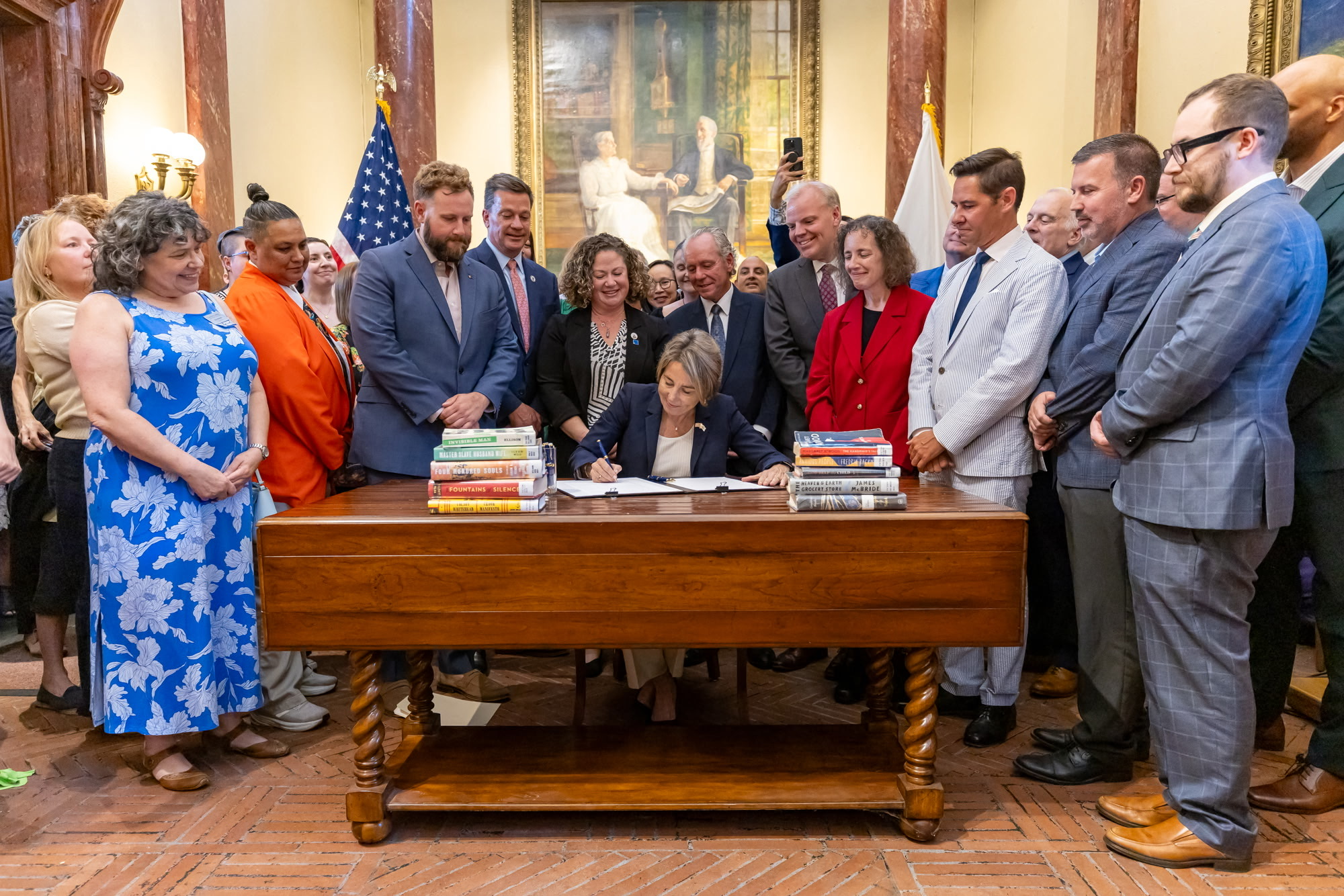
Gov. Maura Healey signed legislation Monday, Aug. 10, aimed at preventing politically-motivated book removals from Massachusetts schools and public libraries, a measure inspired in part by a 2023 controversial book ban in North Attleborough.
Healey signed An Act Regarding Free Expression during a ceremony at the Franklin Public Library, joined by state Rep. Adam Scanlon (D-North Attleborough), lawmakers, librarians, educators and advocates.
The new law establishes statewide standards for how school and public libraries select materials and respond to challenges, requiring a formal and transparent process before challenged materials can be removed.
“This bill is about protecting the freedom to read, to learn, to ask difficult questions and to encounter ideas we might agree or disagree with,” Healey said. “It’s also about protecting our teachers and librarians and allowing them to do their jobs.”
For Scanlon, the signing marked the culmination of an effort closely tied to the removal of a poetry anthology from an elementary school library in his hometown following a single complaint.
“What started with a local incident in North Attleborough has now become a statewide protection for the freedom to read and the free exchange of ideas,” Scanlon said in a statement following the signing.
The effort dates to 2023, when “Woke: A Young Poet’s Call to Justice” was removed from the Martin Elementary School library.
The book, which addresses topics including social justice, discrimination and identity, was taken off the shelves after a parent’s complaint without public notice or a formal School Committee vote.
The decision did not become widely known until months later, prompting community debate over how challenges to school library materials should be handled. The book was eventually returned to the library, and the School Committee revised the district’s policy for future challenges.
Scanlon, who publicly opposed the removal, later joined state Rep. John Moran (D-South End) in filing legislation to establish protections and review procedures statewide.
The original House bill was filed in January 2025 and reported favorably by the Legislature’s Joint Committee on Tourism, Arts and Cultural Development that October. The Senate approved its version in November 2025, followed by the House in a 153-3 vote June 10.
After lawmakers reconciled differences between the two versions, the Legislature gave the final measure approval on July 31 and sent it to Healey.
“I’m grateful to my colleagues in the Legislature, and everyone who helped bring this legislation across the finish line,” Scanlon said. “Seeing the governor sign it into law today is a meaningful moment, and I’m proud that Massachusetts is standing up for the freedom to read and the First Amendment.”
What the law changes
Under the new law, decisions about materials included in school libraries must be based on educational value and age appropriateness, rather than personal, political or religious views.
School districts must adopt written policies governing both the selection of library materials and how complaints are handled. Only current students, parents or guardians and school staff may request that school library materials be reconsidered.
Challenged materials generally must remain available while the review takes place and cannot be removed without a vote of the local school committee. The process includes public notice and an opportunity for parents and community members to be heard before a final decision.
“This law does not prevent parents or community members from raising legitimate concerns about library materials,” Scanlon said. “It ensures those concerns are addressed through a fair, transparent, and consistent process rather than arbitrary or politically-motivated removals.”
A school committee may remove material only after finding, by clear and convincing evidence, that it is not age-appropriate for any student at the school or that, considered as a whole, it is devoid of educational, literary, artistic, personal and social value.
Parents and community members may challenge those decisions in court.
Public libraries must also adopt written policies governing the selection and reconsideration of materials under standards intended to prevent removals based on personal, political or religious objections.
The law also protects librarians and school employees from professional discipline or employment consequences for selecting materials in good faith. It directs the Massachusetts Board of Library Commissioners to develop model policies and resources for school and public libraries and to report annually on challenges across the state.
Increasing concerns
Attempts to restrict access to library materials have also increased elsewhere in Massachusetts in recent years.
Maria McCauley, president of the American Library Association and director of the Cambridge Public Library, said libraries across the state have seen a rise in such efforts.
A 2023 Massachusetts Board of Library Commissioners survey found that 48.5% of responding school librarians reported reconsidering displays, books, or other featured items because of negativity surrounding book challenges, according to McCauley.
“Library workers have faced unprecedented threats and harassment,” she said. “Intellectual freedom and the right to receive information in libraries are foundations of thriving democracies.”
McCauley said the new law provides libraries with clearer guidelines for responding to those challenges while safeguarding access to information.
Several of Scanlon’s former North Attleborough teachers also attended the ceremony.
“The educators who taught and inspired me, along with the members of the North Attleborough and Attleboro school committees, continue to inspire me in this work,” Scanlon said. “They remind me why it is so important that we give our students the opportunity to learn, ask questions, encounter different ideas, and ultimately think for themselves.”