

By Geena Monahan—For the North Star Reporter
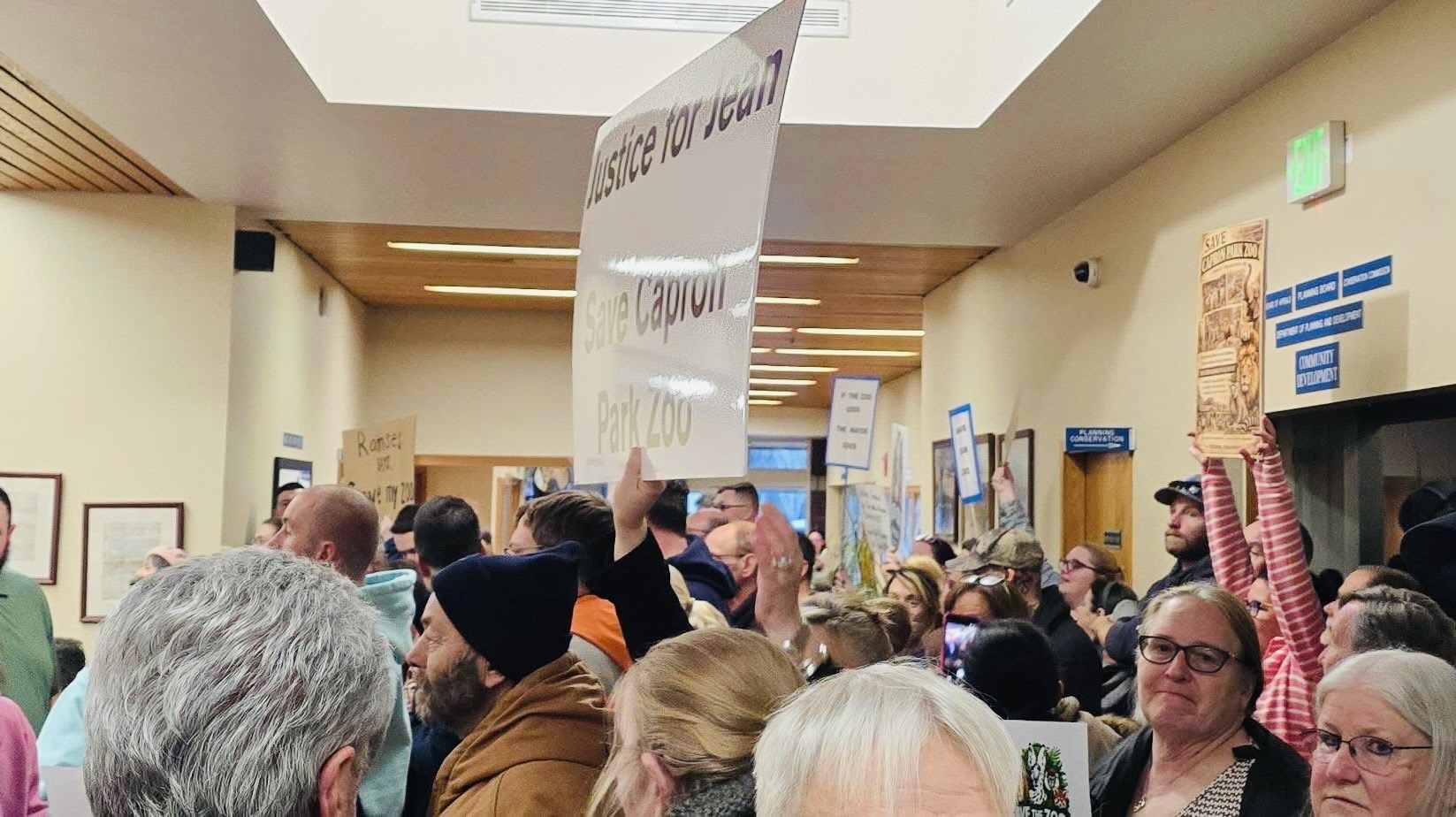
The Attleboro City Council chambers were filled past capacity as more than 180 residents packed City Hall, while others gathered outside as a debate over the future of Capron Park Zoo unfolded.
Inside, residents wearing “Save Capron Zoo” shirts and holding hand-painted signs reacted throughout the night with cheers, chants and visible support as councilors took up the issue during the meeting on Tuesday, March 24.
Councilor Jay DiLisio introduced a resolution under new business at the outset of the meeting, calling for the administration to pause any irreversible actions tied to its proposed plan to transform Capron Park Zoo into a nature reserve and wildlife rehabilitation center and to bring any major changes before the council through a formal public process.
“This is the right move at the right time,” DiLisio said, drawing a round of applause.
Resolution calls for public process
The resolution states that any proposal to discontinue or materially alter zoo operations — including repurposing facilities or changes to its funding structure — should be presented to the City Council and subject to a public hearing.
It also calls on the administration to refrain from rehoming animals, demolishing structures or permanently redefining operations until that process takes place, and urges the city to explore all reasonable options to keep the zoo open for up to two years.
Council President Todd Kobus clarified that Tuesday’s vote was only to admit the resolution as new business, not to approve it. The motion to admit the resolution passed 9–2.
No timeline was provided for when the resolution will return for further discussion or a vote, though Kobus asked the administration to provide additional information regarding the use of free cash to support the zoo.
Councilor Sara Lynn Reynolds, who voted against bringing the item forward alongside Council Vice President Laura Dolan, criticized the process.
“This should have gone through a committee like it always does,” Reynolds said. “Everyone would have had a chance to speak at a public hearing.”
Mayor defends approach amid backlash
Attleboro Mayor Cathleen DeSimone pushed back, both on the resolution and criticism of how the plan was introduced, framing the issue as a financial one, rather than a political debate.
“I understand that some want to turn this into a platform, but I will not engage in political battles,” she said. “It will only detract from what is indeed an important financial matter.”
At the same time, she acknowledged the rollout caught many off-guard, and she understood residents’ concerns.
“There’s no good time for bad news,” she said. “But I understand that a lot of bad news at once was not optimal.”
DeSimone maintained that the underlying issues have been building for years and should not have come as a surprise, pointing to ongoing budget discussions and prior warnings about the zoo’s long-term sustainability.
The city, she said, is facing a $2.5 million deficit, with projections showing a gap that could exceed $8 million in the next fiscal year — a reality she said is forcing difficult decisions.
“We cannot be afraid to ask tough questions and make hard choices,” DeSimone said, adding that she remains “steadfast” in the direction laid out.
Budget pressures and long-term costs
Budget and Administration Director Mason Lord said the city’s financial challenges extend well beyond a single budget cycle, with rising costs continuing to outpace revenues.
Among these are an 8.4% increase in active employee health insurance costs, a 21% increase in retiree health programs, annual pension increases of 6.6% and rising school transportation and operational expenses.
These factors have pushed projected expenditures to about $202.8 million, against $200.3 million in revenue this year, contributing to a current deficit and a larger gap on the horizon.
“If we don’t make changes,” Lord said, “we’re going to be having this same conversation about other departments.”
The zoo represents one piece of a larger financial challenge, explained Lord, with operating costs of about $1.78 million and revenues covering less than half. Those costs, he said, are expected to approach $2 million annually.
Lord added that years of underinvestment have contributed to growing maintenance needs and significant capital costs outlined in the zoo’s strategic plan.
“The city failed the zoo,” he said. “It has not prioritized the zoo for the past 40 years.”
He noted that past administrations were balancing competing needs across departments.
“We have one pie,” Lord said. “Ultimately, the zoo was left behind.”
Projected capital needs now exceed $28 million, including $4.1 million in utility infrastructure upgrades, $10 million in pavilion improvements and new or expanded exhibits, including a $12 million white lion exhibit.
Even under optimistic assumptions for attendance and revenue growth, Lord said the numbers remain difficult to reconcile.
“If you follow the attendance growth and proposed ticket increases, the numbers don’t foot,” he said. “They don’t foot significantly.”
If fully implemented, the zoo’s strategic plan could push total operating and debt-related costs to nearly $3 million annually, while revenues would remain under $1.5 million — leaving a continued gap that Lord said will only widen in future fiscal years.
Questions on the plan and assumptions
Councilor Jonathan Tavares said the administration’s memo lacked long-term financial projections under a proposed transformation plan, making it difficult to evaluate whether the approach would be sustainable over time.
“If we’re going to be intellectually honest, we have to see that this will be sustainable in the years after,” he said.
Others questioned whether all potential revenue options had been fully explored, including adjustments to admission pricing or expanded outreach. Councilor Michael Angelo, pointing to the crowd turnout and visible support, suggested the zoo may be undervalued.
“It’s an incredible bargain the way it is,” he said, adding that higher ticket prices could be part of the conversation.
Some councilors also warned that early steps tied to the proposal — including halting animal acquisitions and limiting certain operations — may already be affecting public perception and the zoo’s future viability.
Councilor Erin Morrissey said those decisions risk undermining confidence at a critical moment.
“I think a lot of trust has now been destroyed,” she said.
Councilor Diana Holmes raised similar concerns, arguing the city has not yet explored alternatives to support the zoo, particularly when it comes to fundraising and outside funding.
“This is disrespectful at best and unlawful at worst,” Holmes said of the mayor’s plan. “We have not exhausted all the efforts to make this next chapter successful.”
As the meeting adjourned, residents again broke into chants of “Save our zoo” as councilors and city officials left the room.