
By Geena Monahan—For the North Star Reporter
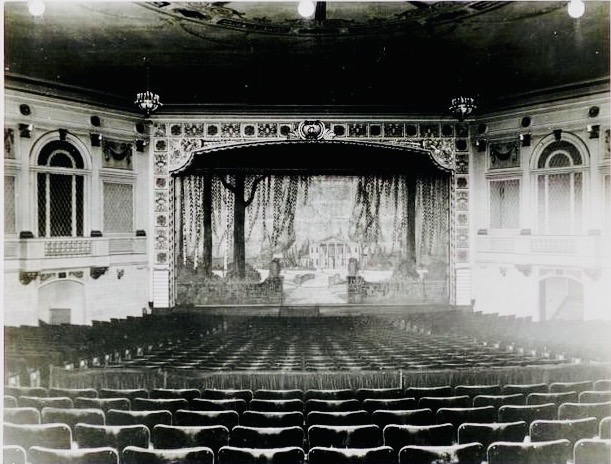
Beneath glowing chandeliers and gold-trimmed walls, nearly 1,500 people once filled the seats of North Attleborough’s Community Theatre — watching films, attending concerts and gathering for meetings in one of the town’s grandest spaces.
Today, all that remains is a single granite cornerstone —a relic set to be preserved and shared more than 40 years after the theater’s demolition.
The North Attleborough Housing Authority plans to donate the cornerstone, which dates to 1928, to the Falls Fire Barn Museum, where officials say it can finally be appreciated as a tangible piece of the town’s past.
“It’s huge — a few hundred pounds,” said David Leco, resident services coordinator for the Housing Authority. “Maybe three or four feet tall, about two feet wide. It’s solid granite. And it just says ‘1928.’”
The stone has been in the Housing Authority’s possession since 1983, when its downtown complex was built on the former theater site at 20 S. Washington St., a year after the building was demolished. In the decades since, it was moved to a remote property at Circle Court and largely overlooked.
“I don’t think anyone paid attention to it, or maybe its meaning was lost,” Leco said.
That changed when Leco, a North Attleborough native, recognized its significance shortly after starting his role. With new leadership at the Housing Authority and renewed interest in local history, officials decided the cornerstone should be placed where the public could see it.
“I grew up here, so when I saw it, I said, ‘That’s got to be it,’” he said. “One of our maintenance guys is a townie too, and he confirmed it.”

A theater at the center of town life
When the Community Theatre opened in 1929, it was more than just a movie house — it was one of the largest gathering spaces in North Attleborough.
Built at a cost of roughly $300,000, the theater featured a spacious lobby, an 80-foot-wide foyer adorned with fabric hangings and indirect lighting, and an auditorium that seated around 1,500 people. Plush red carpeting, gold detailing and chandeliers gave the space a sense of grandeur, while a Wurlitzer pipe organ accompanied early films and live performances.
Unlike many theaters of the era, it had no balcony. Instead, a sloped, “stadium-style” floor ensured clear views from every seat.
The stage hosted films, concerts, live shows and even town meetings when large crowds were expected, making it a hub for civic and cultural life.
Opening week featured films like “The Wolf of Wall Street,” starring George Bancroft, and “Lucky Boy” with George Jessel, part of the early wave of “talking pictures” that transformed the moviegoing experience.
Hollywood stops in North Attleborough
By the early 1950s, however, movie theaters across the country were beginning to feel the effects of a new competitor — television.
In 1951, director Alfred Hitchcock visited North Attleborough as part of “Movietime USA,” a nationwide campaign to draw audiences back to cinemas. Hitchcock, along with actors including Dorothy Lamour, posed for photographs in front of the Community Theatre — bringing a moment of Hollywood glamour to South Washington Street.
The campaign ultimately failed to reverse declining attendance, and like many theaters of its time, the Community Theatre struggled to adapt.
Decline and disappearance
The theater ceased operating as a full-time movie house in 1956, though films were occasionally shown into the early 1970s.
There were attempts to revive the space, including classic film screenings and live concerts. For a brief period, nationally known acts such as the Kinks and Seals & Crofts performed there, drawing new audiences.
But the revival was short-lived.
Portions of the building were eventually converted into office space before the entire structure was demolished in 1982 to make way for a new housing complex for elderly residents — the site now occupied by the Housing Authority’s downtown facility.
For many longtime residents, the loss marked the end of an era. Leco recalled stories his grandfather, who worked as an usher at the theater, shared with him.
“He told me that when Pearl Harbor happened, he was working there,” Leco said. “That’s how he got the news — through the newsreels before the movies started.”
Preserving what remains
Today, little physical trace of the Community Theatre remains, making the survival of its cornerstone all the more significant.
Nancy Campbell, director of the Falls Fire Barn Museum, said the organization also has the theater’s original ticket box and is considering how best to display the stone.
The museum already houses another cornerstone from North Attleborough’s former Odd Fellows building and may place the two together, or move them outdoors near a memorial bench dedicated to firefighter Bud Donnelly.
“We look forward to receiving the cornerstone,” Campbell said. “It’s an important part of the town’s history.”
The housing authority hopes to coordinate the transfer in the coming months, once transportation logistics are finalized. A small dedication ceremony is also being planned.
For Leco, the effort is about more than relocating a stone — it’s about restoring a connection to a place that once brought the community together.
“It was a big part of North Attleborough,” he said. “This is just a way to make sure it’s remembered.”