
By Geena Monahan—For the North Star Reporter
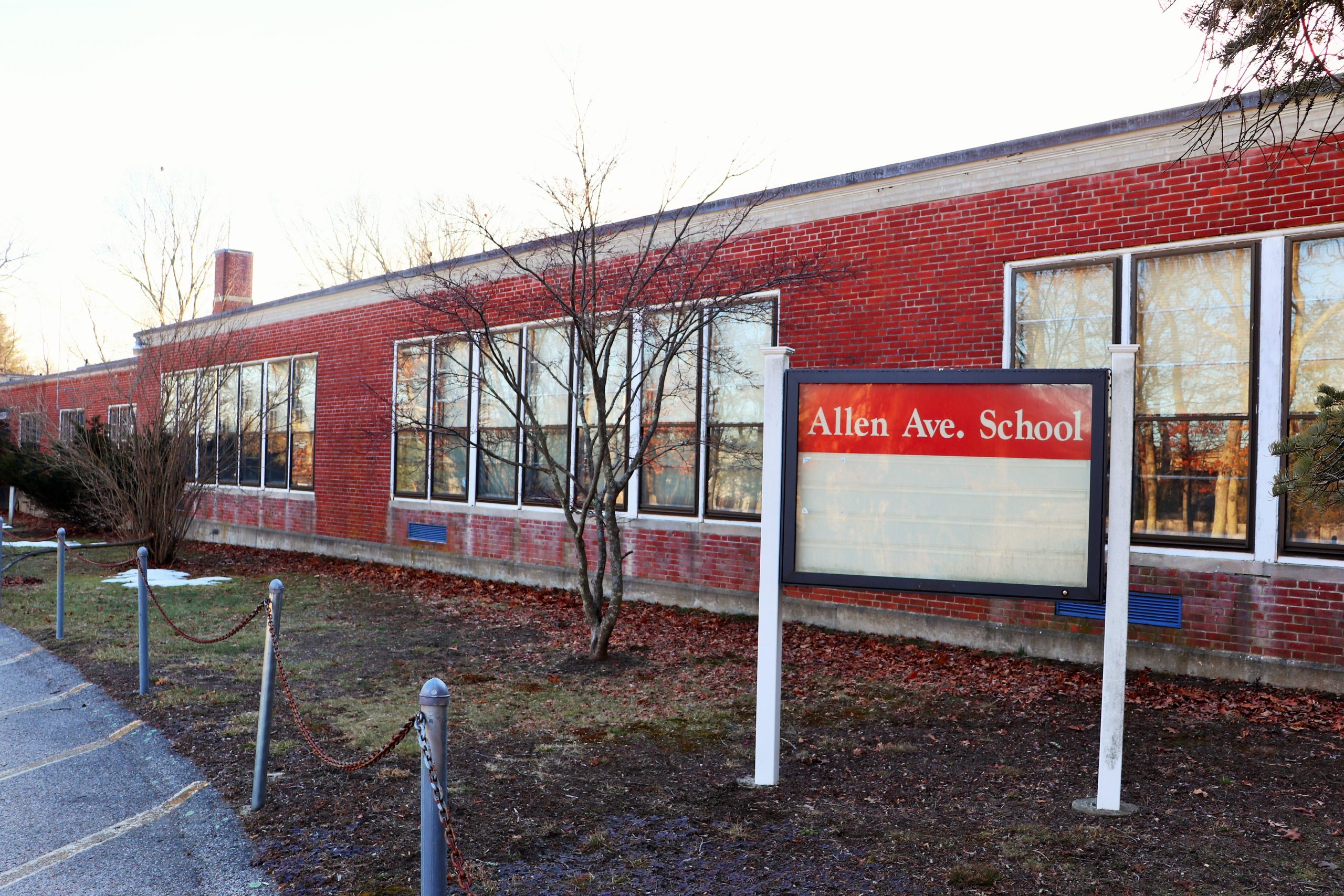
Despite receiving favorable recommendations from multiple town boards and subcommittees, the Town Council voted narrowly on Monday, Jan. 12 to reject a proposed rezoning of the former Allen Avenue School site from residential to commercial.
Councilors voted 5-4 against changing the zoning of the 16-acre property at 290 Allen Ave., which is currently zoned R20 residential. The Planning Board, Bylaw Subcommittee, and Economic Growth and Sustainability Subcommittee each previously voted 3-2 to recommend rezoning. The measure required a supermajority of six votes to pass.
Town Manager Michael Borg has advocated for changing the zoning to make the long-vacant property more attractive to potential developers and avoid the pressures of the state’s affordable housing laws.
Councilor’s response
Several councilors who voted against the rezoning said their opposition was rooted in timing and process, rather than resistance to development.
Councilor Dan Donovan, who also voted against the proposal as a member of the Bylaw Subcommittee, said he supports commercial and mixed-use development, but believes the town should pursue a mixed-use overlay that has long been in development by the Planning Board.
“My vote is not against development,” said Donovan. “It’s a vote for sequencing things the right way.”
Donovan added that adopting a mixed-use overlay would allow the town to test market interest through a request for proposals without changing the underlying zoning prematurely.
Councilor John Simmons echoed that reasoning, saying he would like to see what proposals might come forward under the current zoning or a mixed-use overlay before rezoning the property outright.
Vice President Keith Lapointe, who also voted against the change, said the town is not currently facing a shortage of commercial space along Route 1 and cautioned against rushing a zoning change.
“This land is adjacent to Route 1, but it’s clearly in a residential area,” said Lapointe. “Sometimes you have to take a step back and see if the timing is right.”
Other councilors argued that rezoning the property would give the town more control and flexibility in shaping redevelopment.
During the public hearings process throughout late 2025, dozens of residents voiced opposition to changing the zoning and urged the town to keep Allen Avenue residential.
One such resident, Dick Kieltyka, addressed the council Monday night in no uncertain terms.
“Anything short of a ‘no’ vote violates your commitment to residents who put their trust in you,” he said. “Anything but a ‘no’ would be a slap in the face of the residents who elected you.”
Councilor Laura Wagner, who voted in favor of the change, said she was persuaded by feedback from town officials and consultants indicating there has been little interest in the property under its current zoning. She also warned that a mixed-use zoning could result in a larger residential development than nearby residents want.
“Commercial zoning could bring in something that blends with the neighborhood,” said Wagner, citing the possibility of a one- or two-story medical or office building.
Councilor Kevin McCarthy, who also voted in favor, pointed to Bob’s Market in the residential Arnold Road area and Mini Systems Inc.’s warehouse on David Road as examples of commercial uses that have coexisted with nearby neighborhoods without disruption.
Borg, who has supported the zoning change since it was first brought before the Planning Board in August 2025, said rezoning would help ensure the “highest and best use” of the property and reduce the risk of development under Chapter 40B, which allows developers to bypass some local zoning rules for affordable housing projects.
He also emphasized that the town would retain control over the property throughout any request for proposals process.
“The town retains the entire decision-making process over what would be built,” said Borg before the final vote was taken, noting that rezoning would not force the town to sell the land.
Council President Justin Pare and Councilor Mark Gould joined Lapointe, Donovan and Simmons in voting against rezoning. Councilors John Costello and Annie Slobogan joined Wagner and McCarthy in voting in favor.
Councilors unanimously voted to refer a newly completed multi-use overlay district bylaw amendment to the Bylaw Subcommittee and then to the Planning Board, which drafted the measure
According to the amendment’s submittal, the proposal is a “modernization effort” by the town aimed at “economic development that targets the latest industries, promotes high-value commercial development, and allows more uses all by special permit.”